
The historical instruments

until WW II


The Cathedral seems to have had an organ as least as early as 1377, because it is recorded that in that year Emperor Charles IV heard the Te Deum sung in the cathedral with organ: probably antiphonally. Michael Praetorius mentions this Blockwerk instrument many times in his “Syntagma musica”, although by the time of writing it had been taken down, presumably by Heinrich Compenius, who seems to have received at least some of the pipes in part-payment for his new instrument begun in 1604. Praetorius compares it a number of times with the organ in Halberstadt, then still in existence but no longer playable. However, nothing is really known of this instrument; even its position in the cathedral is uncertain, although it was probably not on the west gallery, where it would not have served any very useful purpose. It very possibly stood over the south door.

In 1536, the organ builder and monk Brother Michael built an organ for the cathedral in Halle, which was confiscated by the cathedral chapter in Magdeburg and brought here in 1541. Heinrich Compenius possibly repaired this instrument in 1603 while making preparations for the building of the new instrument which he erected in the cathedral beginning in 1604; as he did so he recorded the specification. It will be seen that this organ, like many others of its time, included stops making up a Plenum, which were not in "Chorton", as well as others which were, making it essentially two instruments in one. But these stops could naturally not be used together. This organ seems to have been worked on many times, to have been enlarged and reduced again in size; it was unplayable for many years, but was repaired by the cathedral organist Tegtmeyer, as we read in a cathedral guide book of 1716:

“Eigentliche Beschreibung / Der Welt berühmtem / DOM KIRCHE, / Fundation, Raritäten / und Zieraths / ......
/ der Stadt Magdeburg”, Ausgabe von 1716:

“Proper description / of the World famous /
CATHEDRAL CHURCH, / Foundation, Rarities / and Decoration ....
of the city of Magdeburg”, Edition of 1716:

15. Die kleinere Orgel befindet sich über dem Eingange in das Hohe Chor von der Seiten / wenn man zur Paradieß-Thüre herein kömmt, von welcher der gemeine Mann lange vorgegeben, als wenn sie vom Teuffel besessen wäre, so aber ganz falsch und irrig, indem selbige nur durch lange Unachtsamkeit unbrauchbar worden, nunmehro aber durch die Geschicklichkeit des jetzigen Organisten and der hiesigen hohen Stiffts-Kirche, Herrn George Tegtmeyers, Anno 1715. in solchen Stand wieder gebracht ist, dass sie allezeit bey der Musique gerühret wird.

15. The smaller organ is located over the entrance to the choir on the side, where one comes from the Paradise porch; the common man had long said of it, that it wass possessed by the devil, but this is wrong and misled, because it had simply become unplayable by long years of neglect. But it has now, in 1715,  been repaired, thanks to the craftsmanship of Mr George Tegtmeyer, the present organist of this high foundation, and is always played as accompaniment to the music.

16. Über diß ist auch ein Positiv auf einem sonderlichen Chor von lauter hölzernen Pfeiffen, mit 6. Stimmen und 1. Tremulant, so Anno 1619. zu Cassel von Georg Weißlanden,  aus Amberg bürtig gemacht, einen sehr lieblichen und anmuthigen Resonanz giebet, und vor der Reperation der vorhergehenden Orgel zur Music gebraucht worden.

16. Apart from this, there is also a Positive on a special gallery, (this was a wooden platform extending westwards from the very narrow screen) which has only wooden pipes. It has 6 stops and a tremulant, and was made in 1619 in Cassel by Georg Weißland, who came from Amberg; it gives a very delicate and sweet tone, and was used for accompaniment until the repair of the aforementioned instrument.


The organ built by Heinrich Compenius the younger from Halle in 1604 / 1605 (or possibly 1615?) was considered to be one of the great instruments of its time. The payment of the last installment to the organ builder is recorded in 1605; however, a cathedral guide book by the dean of the cathedral, J.F.W. Koch (undated, but plainly written at a time when the Compenius organ was still standing), remarks that

20. Ehe man zur Abseite fortgeht, wird man wohl thun, einige Schritte in die Mitte des Schiffs der Kirche zurückzutreten um einen Blick auf die grosse Orgel zu werfen, welche über der Capelle in einer Höhe von 50 bis 108 Fuss steht und mit einer Menge von vergoldetem Schnitzwerk und Statuen geziert ist. Diese können durch Ziehwerke in Bewegung gesetzt werden. So z.B: David und Salomo, welche die Köpfe drehen; zwey Engel mit einer Laute und Zitter, welche sich ganz umwenden; mehrere Trompeter, welche das Instrument ansetzen und abziehen, und ganz oben ein schwarzer Adler, der sich in die Höhe hebt. Auf dem vordern Rück-Positiv steht in der Mitte ein Engel mit dem Notenbuch, der mit einem Stabe den Tact schlägt und zu seinem Füssen und vergoldeter Hahn, der mit den Flügeln schlägt......

20. Before one goes off to the side, it would be well to take a few steps into the middle of the nave and look back towards the great organ which stands above the chapel at a height of 50 to 108 feet and which is decorated by a large amount of gilt carving and many figures. These can be made to mave by means of tracers. So, for example, David and Solomon, who turn their heads, two angels with a lute and a zither, who can turn around completely, a number of trumpeters, who set their instruments to their lips and away again, and, right at the top, a golden eagle, who rises into the air. On the Rückpositiv stands in the middle an angel with a musical score, who beats time with a stick, and at his feet is a golden cock, who flaps his wings.....

Sie hat 43 klingende Register; ist von 1604 bis 1615 gebauet, und ein Werk des damals berühmten Hallischen Orgelbauers Heinrich Compen. ...... Die Wappen und Namen dieser vier Künstler (Anm.: Bildhauer usw wurden benannt) stehen unter an der Orgel, so wie auch folgende Inschrift:

    Laudate Deum in tympano et choro; laudate eum in chordis et organo. Psalm CL

    Anno Domini MDCIV die XV. Maji inchoatum est hoc opus organicum et completum est ultima Novembris anno 1615. opera Henrici Compenii civis Hallensis

It has 43 speaking stops, and was built between 1604 and 1615, being a work of the famous organ builder Heinrich Compen from Halle...... the names and arms of these four artists (the carpenter, sculptor etc. having been named) stand below the organ, as well as the following legend:


    Laudate Deum in tympano et choro; laudate eum in chordis et organo. Psalm CL

    Anno Domini MDCIV die XV. Maji inchoatum est hoc opus organicum et completum est ultima Novembris anno 1615. opera Henrici Compenii civis Hallensis


Its specification was recorded by Michael Praetorius in the second part of his great work Syntagma Musicum, "De Organographia", which was published in nearby Wolfenbüttel in 1619. The organ boasted three manual divisions, including a 32' Principal in the Oberwerk, going down to low F (24' length). There were 42 stops, 2 Tremulants, Birdsong and Drum effects. Praetorius records that there were 12 leather bellows but gives no further details.

Woodcut, 17th century

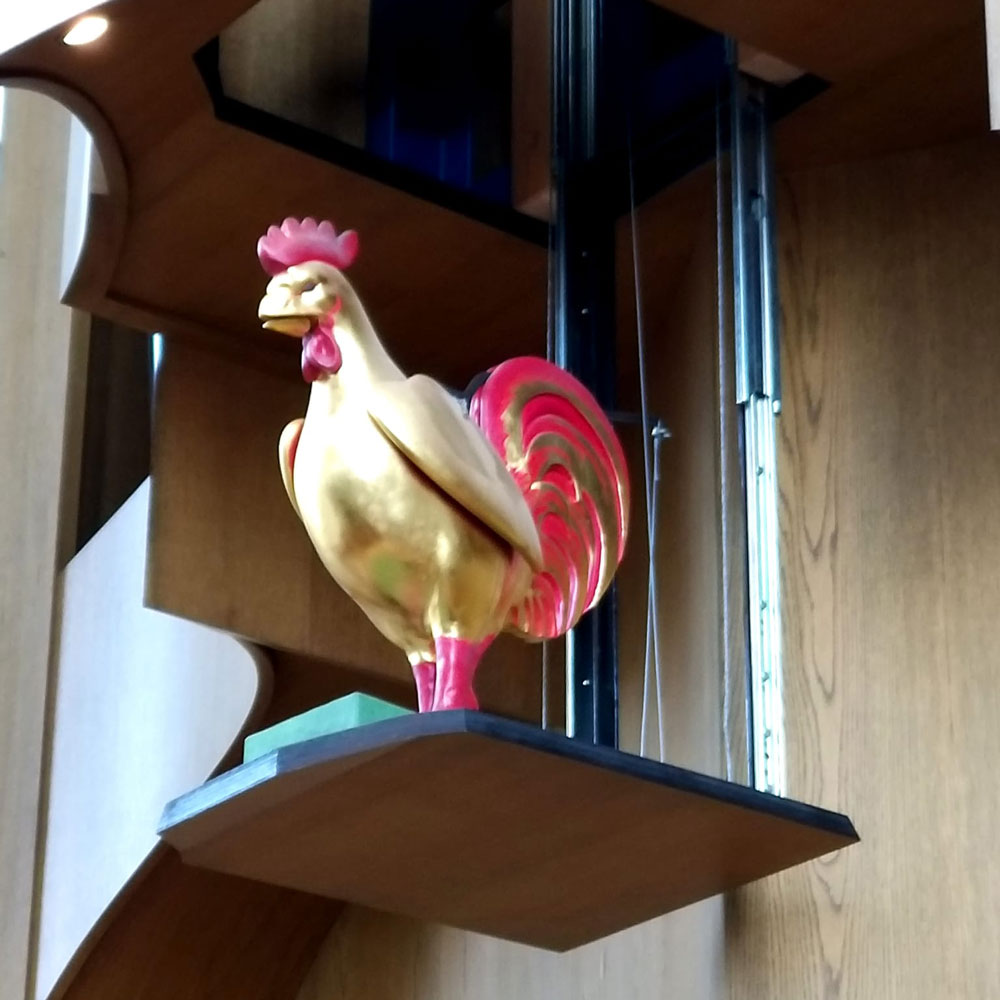
The case of the organ was extremely richly decorated with its 42 figures, 12 of them were moving. A strange ritual involving the golden cock on the Rückpositiv, which  could flap its wings and even apparently crow (although it is reported that this was actually done by blowing on an oboe reed) was often described; here an account from Koch, op cit:

Mit dieser Orgel wird jährlich am Nachmittage des Michaelissontags, insonderheit den zu Tausenden hereinströmenden Landleuten, ein Volksschauspiel gegeben. Nach Absingen eines Liedes wird nehmlich die Orgel mit vollem Werke gespielt, wobey sich sämmtliche daran befindliche Figuren mit ihren musikalischen Instrumenten bewegen. Nach Beendigung des Orgelspiels schlägt der Hahn dreymal die Flügel und es lässt sich eben so oft ein Hahngeschrey hören, welches man durch eine einzelne Orgelpfeife oder auch durch das Mundstück einer Hoboe bewerkstelligt.

Wann und woher dieser seltsame Gebrauch entstanden sey, ist nicht bekannt, wiewohl er ursprünglich zur Feyer der Verläugnung Petri gedient haben mag. Aber es wäre Pflicht, diesem Unfug ein Ende zu machen. Denn abgesehen auch davon, dass dieses Schauspiel der Würde eines Tempels entgegen ist, und manche Verunreinigungen und selbst Verwüstungen zur Folge hat, so ist es auch nicht ganz ohne gefahr, da in dem ungeheuren Gedränge sowohl, als auch durch das sehr besorgliche Herabstürzen der durch Zeit und Würmer wandelbar gewordenen Figuren von einer so bedeutenden Höhe leicht ein Unglück entstehen kann. Dennoch sind bisher die zuweilen gemachten Versuche, diesen Missbrauch abzuschaffen, vergeblich gewesen, weil der Landmann nun einmal so sehr daran hängt, dass die Messleute durch die Aufhebung dieser Volkslustbarkeit sehr zu verlieren meinen.

On the afternoon of the Sunday after Michaelmass this organ is used for an unusual spectacle, especially for the rural population who stream into town in their thousands. That is: after a song a song has been sung, music is played on the full organ, during which all the figures in the case with their instruments are set in motion. After the music is finished, the cock flaps his wings three times and crows as often, which man simulates by using a single organ pipe or by blowing on an oboe reed.


When and how this peculiar ritual became established is unknown, although it perhaps originally had something to do with Peter’s denial of Christ. But it is really necessary to put an end to this nonsense. Apart from the fact that this exhibition is not appropriate to the dignity of a temple, and results in sundry defilement and even devastation, it is not without its dangers, because in the tightly packed masses of people, considering the fact that the figures, which have become unstable through age and worms, could easily plummet down from their great heights, there could easily be a misfortune. Nevertheless, all attempts thus far to end this abuse have come to nothing, because the countryman is so atteched to it, and because the tradesmen at the market fear that they would lose a good part of their income, if this popular entertainment were to be abolished.  

Eustachius Zehne, “Die Hochstiftskirche / oder / der Dom in Magdeburg”, 1784: Der Zulauf des Volkes ist an diesem Tage sehr groß, vorzüglich von jungen ledigen Landleuten, welche glauben, daß sie, wenn sie den Hahn haben krähen hören, noch in demselben Jahre sich verheirathen werden.

Eustachius Zehne, “The collegiate church / or / the cathedral in Magdeburg”, 1784: The throng of common people on this day is very large, especially of young, unmarried country folk, who believe that, if they have heard the cock crow, they will marry within the year.


The organ may well have escaped significant damage during the almost total destruction of the city under Tilly's troops in 1631, although acconts are conflicting and confused. The case however was dismantled during the restoration of the cathedral under Karl Friedrich Schinkel around 1830, it was stored in the tower until it was used as heating material after the second world war. Only the golden cock, and possibly one other wooden figure, remain as testimony to this magnificent facade. The cock now serves "Aktion Neue Domorgeln" as a mascot; a replica will be included in the new west organ.

The organ must had been altered and rebuilt a good deal even before this. August Christoph Meinecke, for example, writing in his Beschreibung der vorzüglichen Merckwürdigkeiten und Kunstsachen der Stadt Magdeburg in 1786 records that

      The organ originally had 43 stops or voices; in the last few years it has been newly repaired and, so to speak, rebuilt, so that now it is really fine and pleasing

and he goes on to give its specification at this time. By the time the new case which was erected in 1830, or at that time,  it lost or had lost its Rückpositiv:

Gehäuse


The appointment of August Gottfried Ritter (1811-1885) as cathedral organist in 1847 made Magdeburg a centre of activity in the organ world. Ritter, who was born in Erfurt and was organist of the cathedral in Merseburg before coming to Magdeburg, was one of the most well-known organ virtuosi of his time, a noted composer and improviser, and also organ consultant to the king of Prussia (Magdeburg was at that time capital of the Prussian province of Saxony.) Liszt, whom he knew well, admired him greatly. Under these circumstances it was no wonder that plans for a new instrument using the  altered 1830 case were soon under way.
 

   August Gottfried Ritter

The builder chosen for this prestigious project was Adolph Reubke, father of the composer Julius (a member of Franz Liszt's Weimar circle), who had his workshop in Hausneindorf in the Harz mountains about 60 kilometres away. He planned and built a four-manual instrument with 88 stops between 1856 and 1861.


The organ had mechanical action and Barker machines. Ritter seems to have been very satisfied with it, although Palme reports that it never worked very well : "One sat at this organ as though on a stubborn horse, and was glad to escape without accident".

The recognisably classical principle of the instrument was still acceptable, even desirable, to an organist of Ritter's generation, although even during his lifetime he was forced to fight many battles with organ builders who were unwilling to build the repeating mixtures on which he as a an influential consultant still insisted. The appointment of Theophil Forchhammer as Ritter's successor in 1886 altered the situation. Palme, who had succeeded Ritter as Royal organ consultant for the province of Saxony, criticised a number of issues, including the fact that Reubke had recycled Compenius pipework, as he did in other instruments as well; Plame regarded these as too small scaled, and remarked that the organ lacked “unity of scale”.
 

Forchhammer.jpg

Theophil Forchhammer

Forchhammer's ideas of good contemporary organ-building were quite different, and in 1906 he was able to commission an entirely new organ from Ernst Röver, who had taken over Reubke's firm in Hausneindorf. This organ had only 3 manuals, but exactly 100 stops. Palme praised its quick and precise pneumatic action and wrote ," The majesty of the full organ, with its full basses (including three 32' stops) is truly overwhelming in its power, fullness and nobility, and fills the immense spaces to the furthest corner."

32 years later Reichsorgelrevisor and musical director of the university of Erlangen, Georg Kempff, brother of the pianist Wilhelm, wrote in a report on the organ that it was “capable of nothing but roaring and whispering”. His conclusion: since an organ "gains its power from high-pitched mixtures", there was nothing to be done except to demolish it. It proved to be unnecessary, however; the bombings of January 1945, which destroyed 80% of the city, spared the west front of the cathedral and the organ, but an apparently deliberately targeted bomb placed between the towers by a low-flying pilot on 17th February of the same year ripped a large hole in the west facade and seems to have irreperably damaged the organ. Photos of a few years later show the largely intact case still standing, but it is clearly empty. Remaining material was collected and the organ removed by the organ builder Felix Brandt. Very possibly, some pipes were melted down to use in the organ which Karl Schuke built in the Remter in 1949. But the legend that the organ was directly hit and was burned is plainly untrue: the gaping hole in the west front is in fact one story too high, and the vaulting above the organ gallery was not damaged.


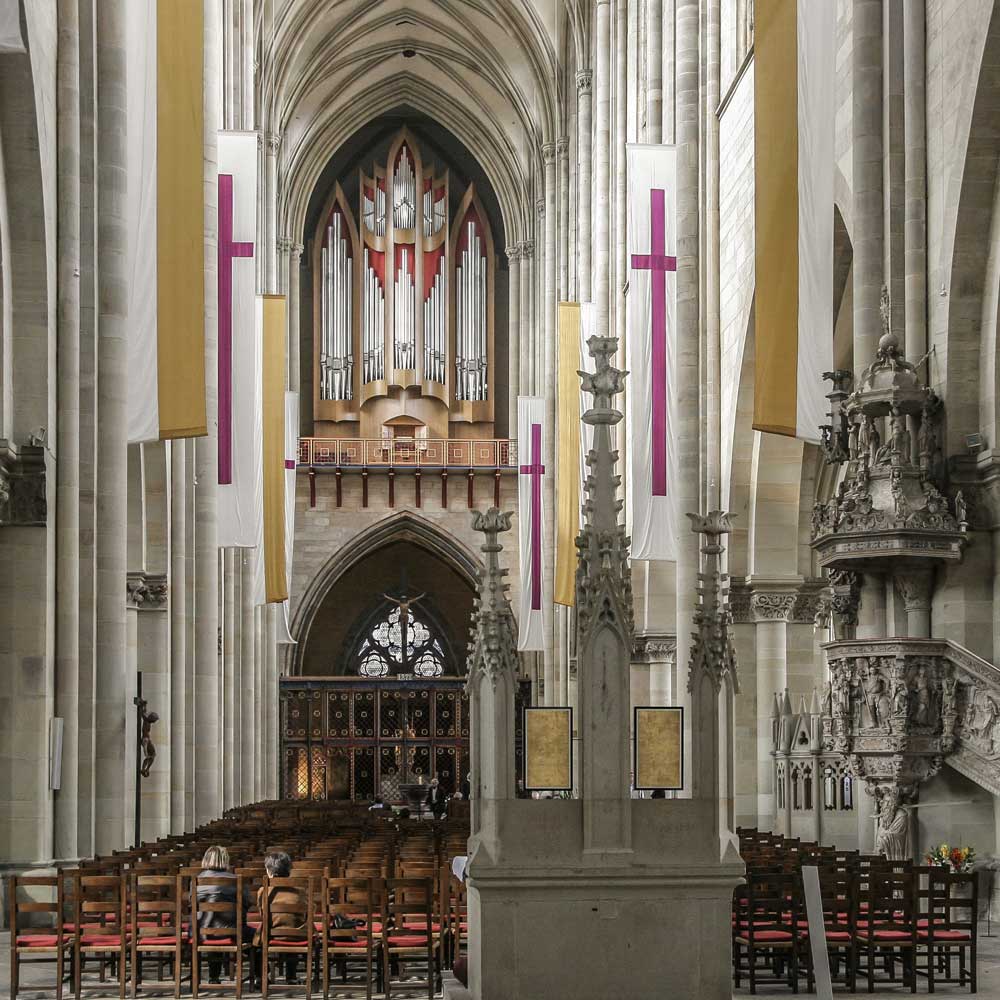
                The great west gallery then stood empty for sixty years.


NEXT PAGE


[START] [Organs (English)] [History] [Choir organ 1536] [The Compenius organ] [The Reubke organ] [The Röver organ] [Golden cock] [Post-War organs] [The new West organ and future plans]